04CDK Global / Taller2022
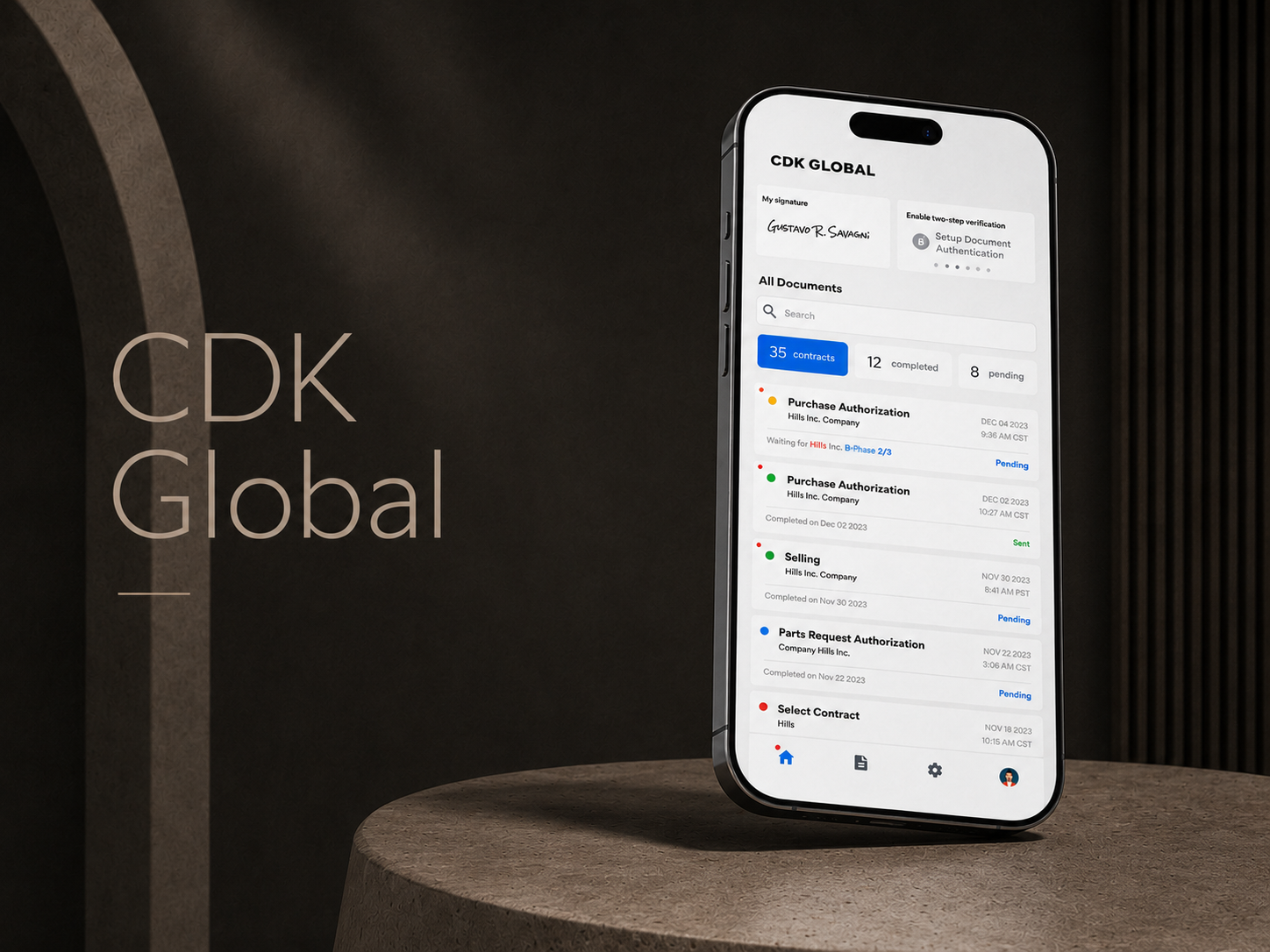
CDK Global
An open enterprise brief turned into a winning product vision
From
To
A product vision and prototype an executive committee could evaluate.
- Role
- Scope
- Team
- Period
Current state
Context, problem and intervention
Context
CDK Global provides software for automotive dealerships. This project happened during enterprise pre-sales, while CDK was evaluating Taller as a delivery partner. CDK had an open capability need, digital documents and contract signing, rather than a defined product solution to design against.
Problem
The capability was understood; the interaction model, flow and product expression were not. Nothing existed for a buying committee to evaluate, cost or believe.
Intervention
I interpreted the brief, built the concept, flows, screens and prototype, and constructed the narrative I then presented to CDK myself.
Brief to vision
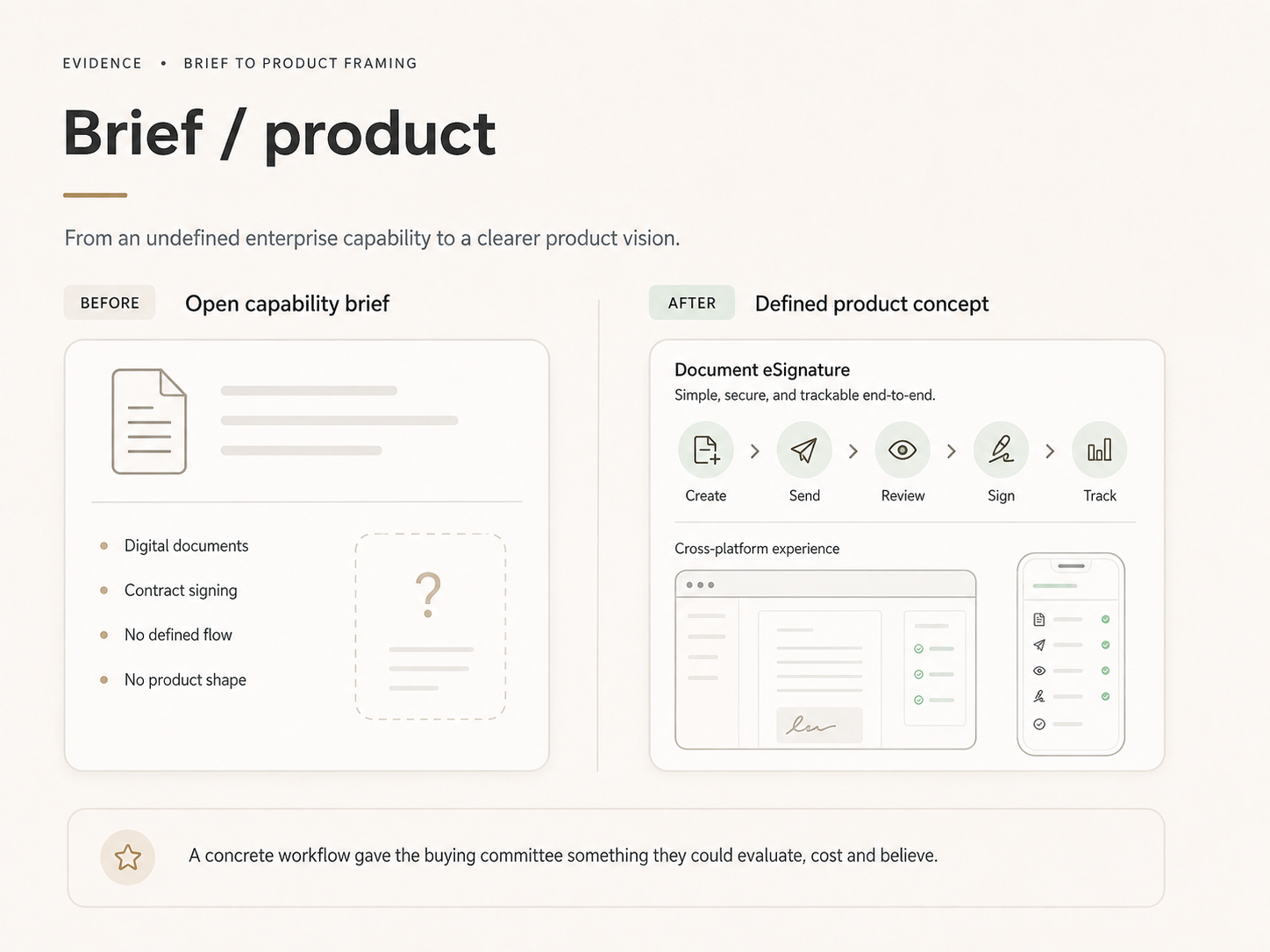
Answer the brief with a product, not a capability deck
The brief described what CDK wanted to be able to offer, with no product shape attached to it.
- Evidence
- A capability cannot be evaluated, costed or believed by a buying committee. A concrete workflow can.
- Decision
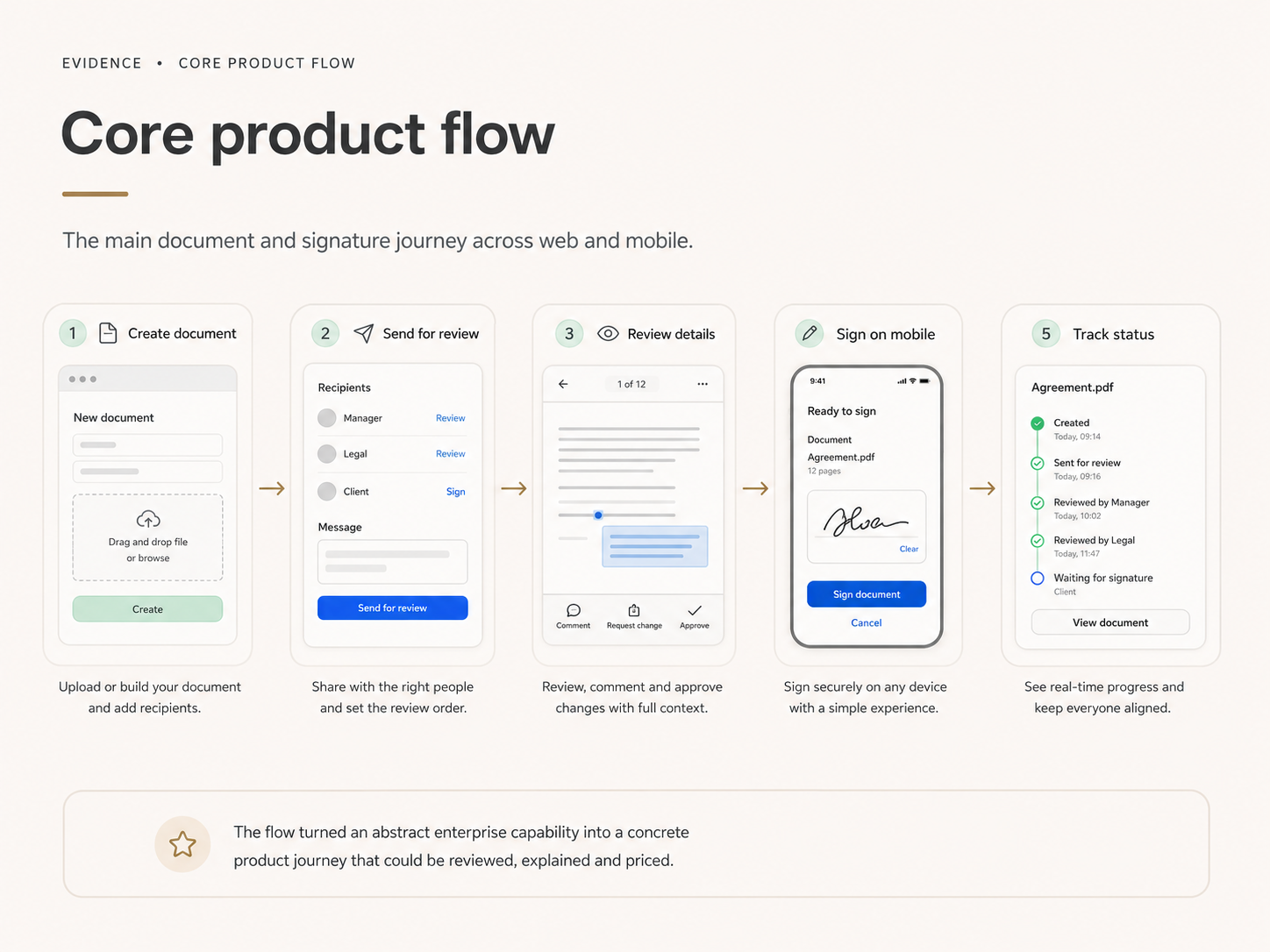
- Define the full journey, create, send, review, sign and follow digital documents and contracts across web and mobile, with clear actions and feedback at every step.
- Trade-off
- Committing to a specific model risked contradicting internal assumptions no one had shared with us.
- Consequence
- The conversation moved from whether the capability was feasible to how the product should behave.
Use hypotheses openly instead of implying research
There was no user access and no research budget at pre-sales stage.
- Evidence
- Briefing analysis and benchmark references were the instruments actually available before a delivery partnership existed.
- Decision
- Build on stated hypotheses and benchmarks, and label them as such in the room rather than dressing them as validated findings.
- Trade-off
- Explicit hypotheses invite challenge in a commercial setting where certainty sells.
- Consequence
- The proposal stayed defensible under questioning, and no usability validation was claimed then or now.
Present and defend the work personally
Pitch narratives are usually carried by commercial leads while designers supply screens.
- Evidence
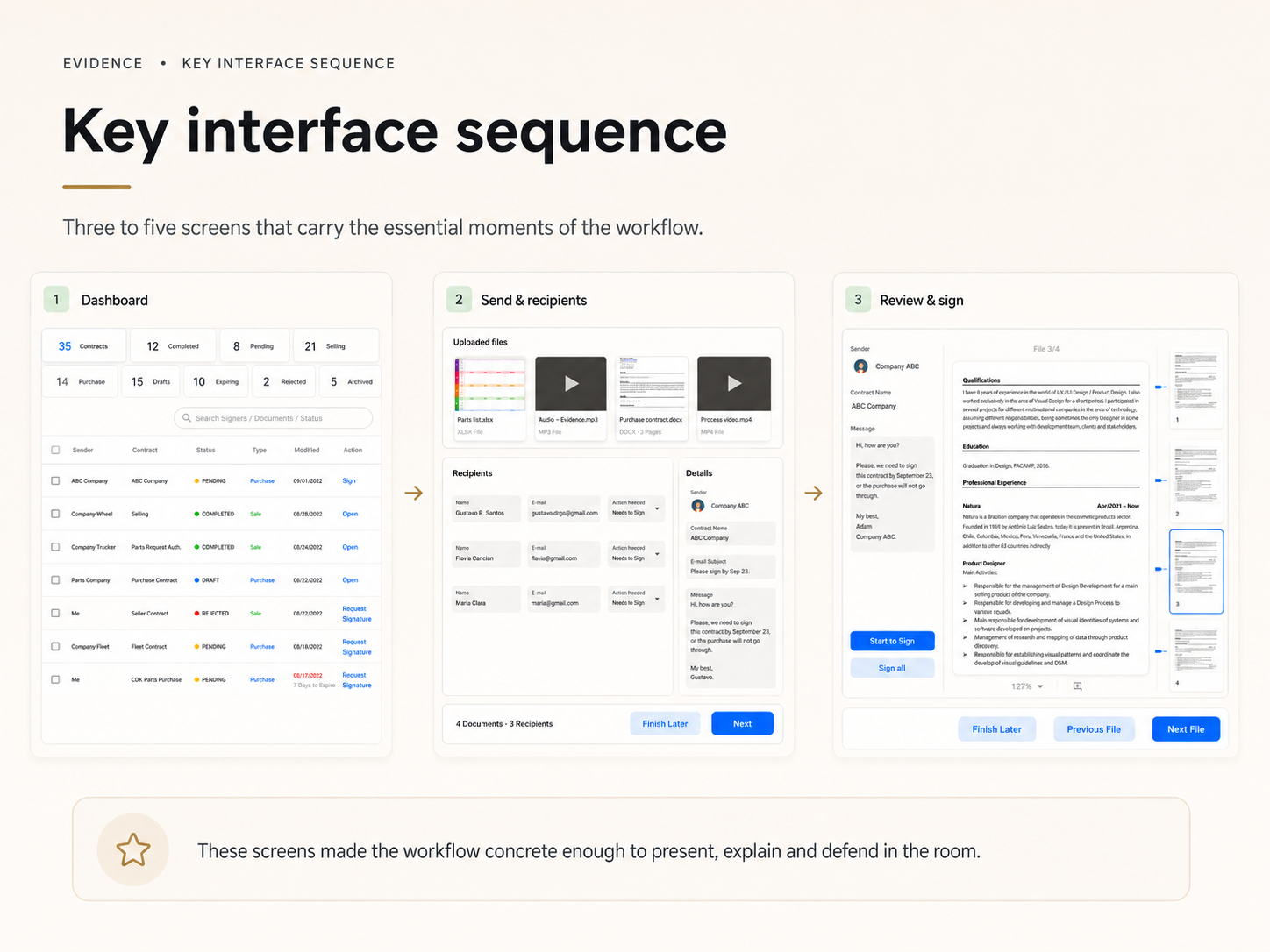
- The decisions in the flow only hold up when the person who made them can explain the reasoning live.
- Decision
- Walk CDK through the prototype directly and defend the decisions in the room, with strategic follow-up from Taller's CTO.
- Trade-off
- Design owned exposure that normally sits with sales.
- Consequence
- Client feedback was strongly positive, and design was visible as a contributor to the commercial result.
Evidence
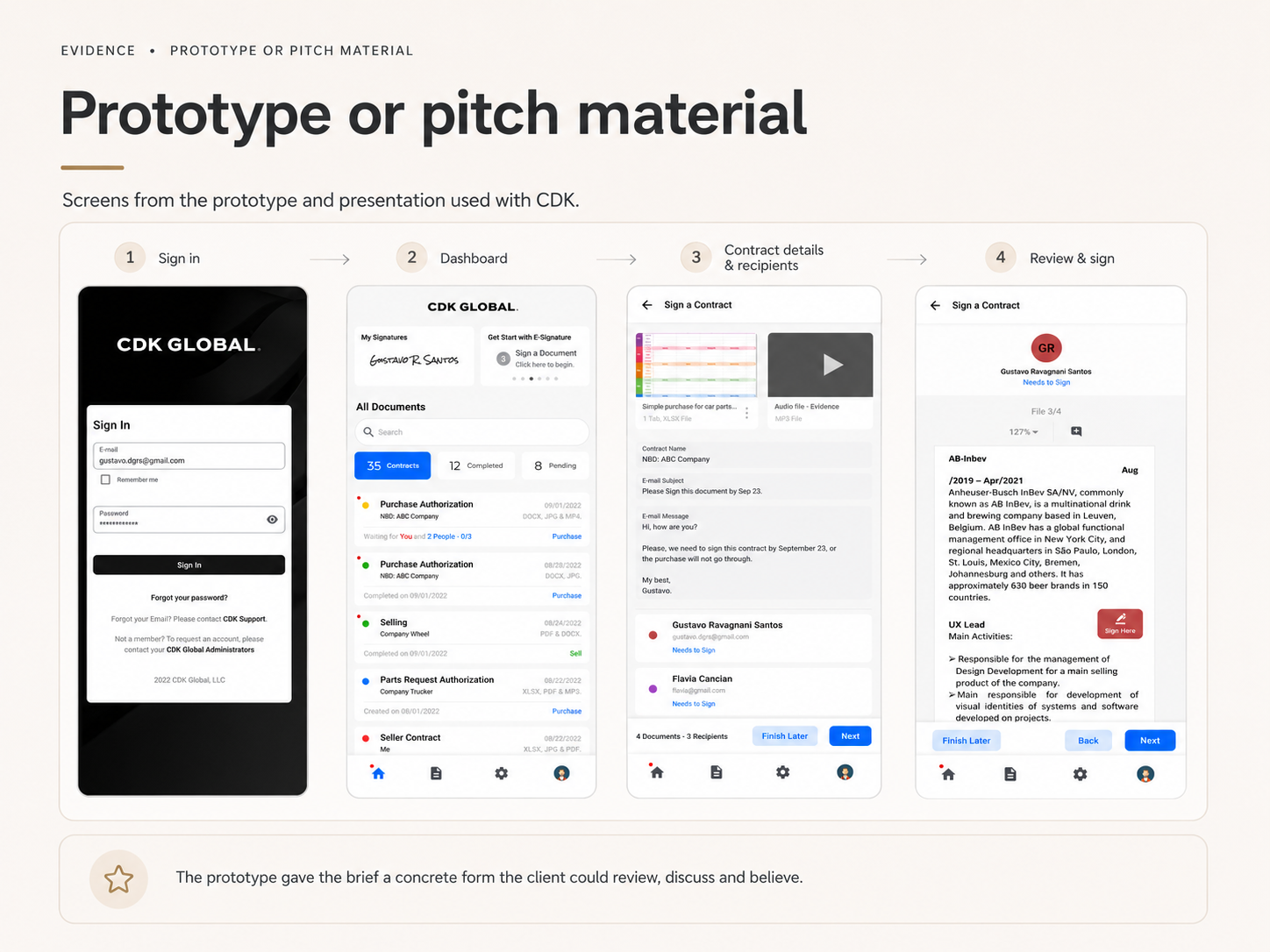
Interactive prototype
The concept running as presented to CDK, in desktop and mobile versions.
Desktop
Mobile
Commercial Outcome Presentation
The narrative presented to the CDK buying committee.
Constraints and trade-offs
- No user access, so the work leaned on briefing analysis, benchmarks and stated hypotheses.
- The vision had to be ambitious enough to win and buildable enough to cost.
- An e-commerce concept was shown to demonstrate breadth across CDK contexts: a side proof point, not the storyline.
Outcome
The account was won by Taller's complete proposal: relationship, technical capability, team and commercial terms. The design contribution was direct and material, and it was not the sole cause of the decision.
Delivered
- Complete product vision: concept, flows, screens and interactive prototype.
- Executive narrative presented directly to the enterprise client.
- Contribution to Taller securing the CDK account and to a lead-design role on the engagement.
Not measured
- Production implementation of the proposed experience.
- Usability validation, adoption or task-performance results.
Next case
AAA Checker