02Porto2025
Chance of Success
From lead temperature to a broker decision system

From
To
What signal helps a broker decide which opportunity deserves attention first?
- Role
- Scope
- Team
- Period
Current state
Context, problem and intervention
Context
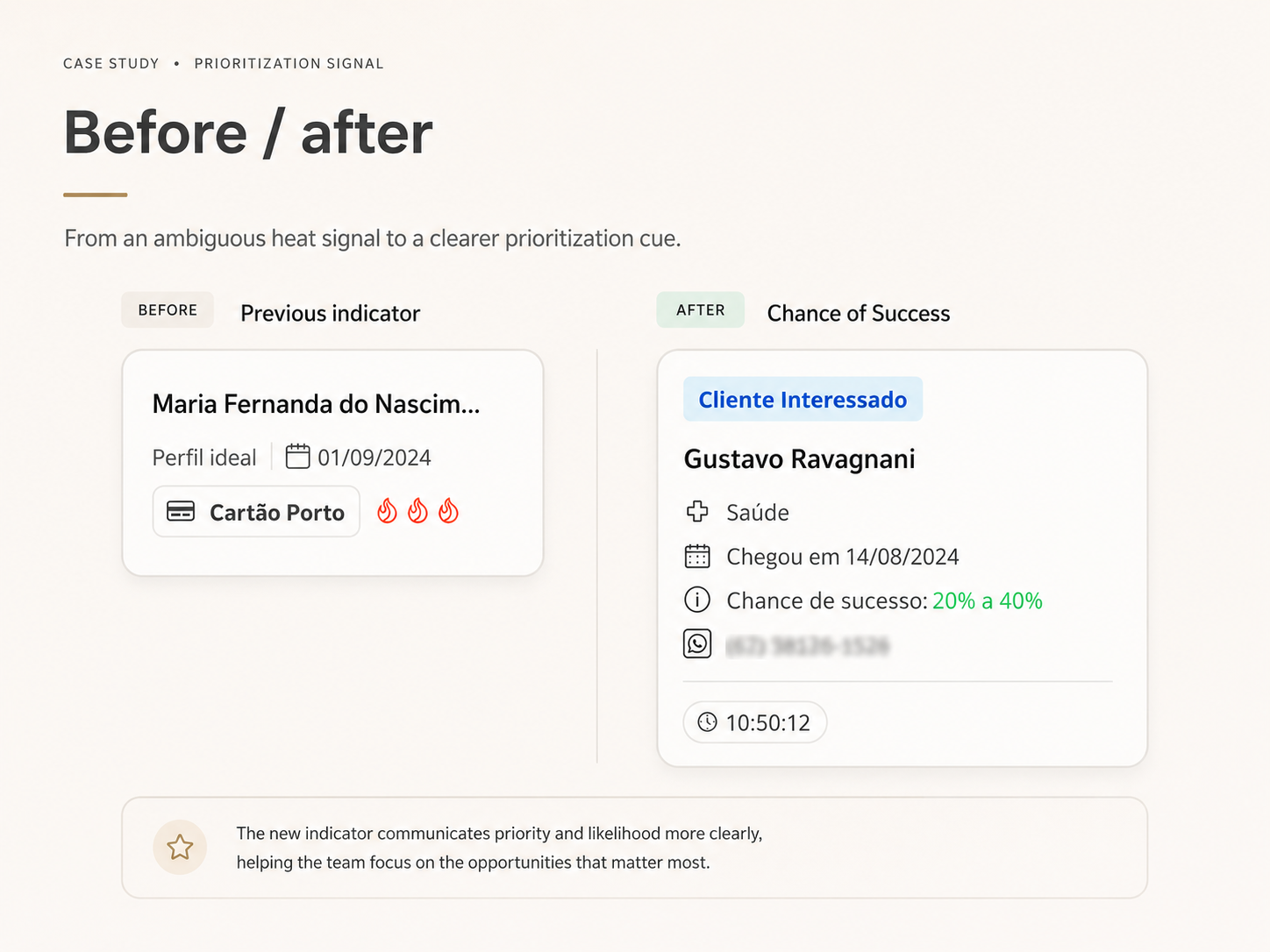
GDO is Porto's opportunity-management product for insurance brokers. Brokers work from a list of commercial opportunities, where a three-level “fire” indicator was used to signal which opportunities deserved attention. The initial request was to expand that indicator from three to five levels.
Problem
Brokers had no trustworthy reason for deciding which opportunity to handle first. The fire indicator carried no documented logic, and adding levels to it would have made the same undefined signal more granular.
Intervention
I reframed the initiative from an icon change to a prioritization problem, defined the decision model with Product, Analytics and Engineering, and designed the card experience, its states and its measurement plan.
Decisions
Treat the indicator as a decision aid, not a decoration
The initiative arrived as a visual refinement: three fire levels to five. Same mechanic, more granularity.
- Evidence
- Existing qualitative evidence did not describe a granularity complaint. It described brokers lacking a defensible reason to choose one opportunity over another.
- Decision
- Replace the temperature metaphor with Chance of Success, a prioritization signal built from available relationship, behavioral and product-context signals.
- Trade-off
- A new mental model costs more to explain and to build than two extra icon states.
- Consequence
- The feature moved from decoration to an explicit prioritization aid connected to broker behavior and to outcomes the team can observe.
Define scoring coverage and fallback behavior
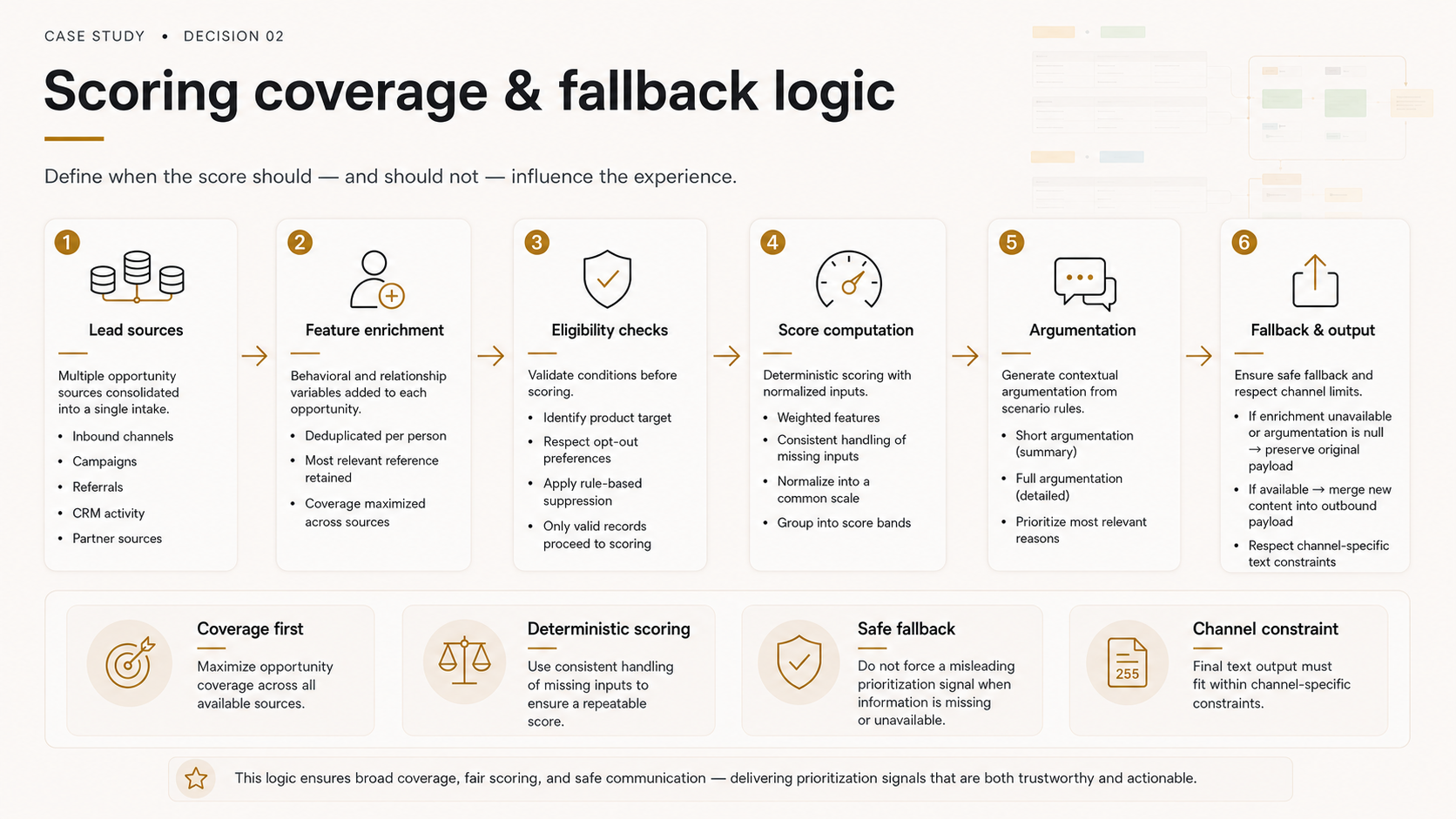
A prioritization signal is only useful when the system knows when it has enough context to use it, and what to do when it does not.
- Evidence
- Opportunity data came from multiple sources with different levels of behavioral and relationship coverage. The scoring layer needed to maximize usable coverage without turning missing context into false confidence.
- Decision
- I worked with Analytics and Business to define the conditions around the score: product identification, feature normalization, opt-out and suppression rules, score bands, and fallback behavior when enrichment could not be safely applied.
- Trade-off
- Normalizing missing inputs improved coverage and kept scoring deterministic, but the result had to remain a relative prioritization signal, not be presented as a calibrated probability of conversion.
- Consequence
- The scoring layer could enrich valid opportunities while preserving the existing payload whenever the new signal was unavailable or suppressed, creating a predictable and safer foundation for prioritization across channels.
Turn behavioral signals into actionable context
The score alone could help prioritize, but it would not explain why an opportunity deserved attention.
- Evidence
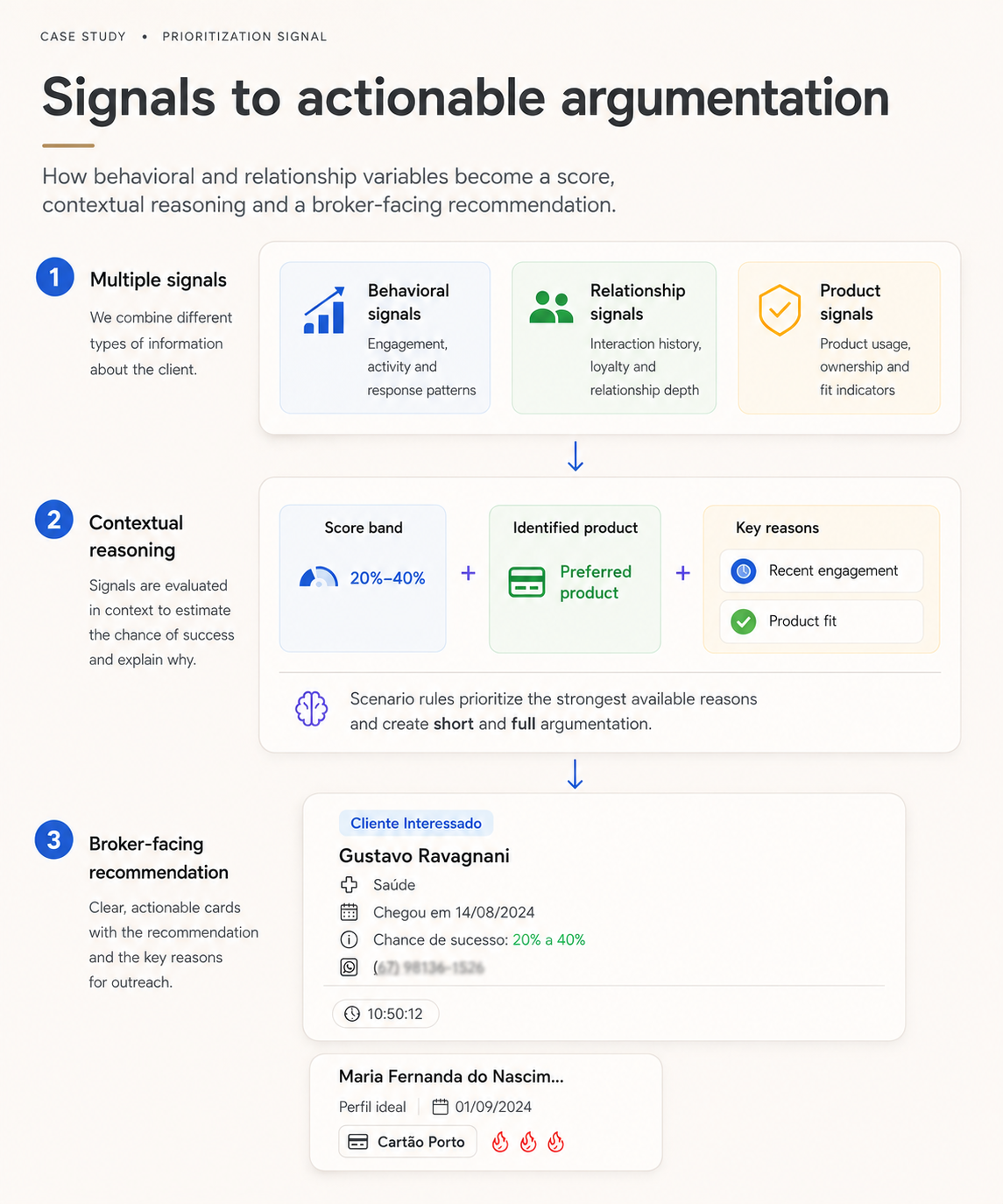
- The outbound engine already combined behavioral, relationship and product signals from different sources. The opportunity was to turn those signals into something the broker could understand and act on without exposing the underlying model complexity.
- Decision
- I helped structure the logic that connects the identified product, score band and relevant customer signals into contextual argumentation. Scenario rules prioritize the strongest available reasons and generate both short and full versions for the final outbound message.
- Trade-off
- More context increases usefulness, but too much explanation adds cognitive load and could exceed channel constraints. The solution therefore prioritizes the most relevant signals and preserves the existing message whenever the new argumentation cannot be safely applied.
- Consequence
- Chance of Success became more than a score: it could be delivered together with concise, contextual reasoning, helping brokers understand both which opportunities to prioritize and why.
Evidence
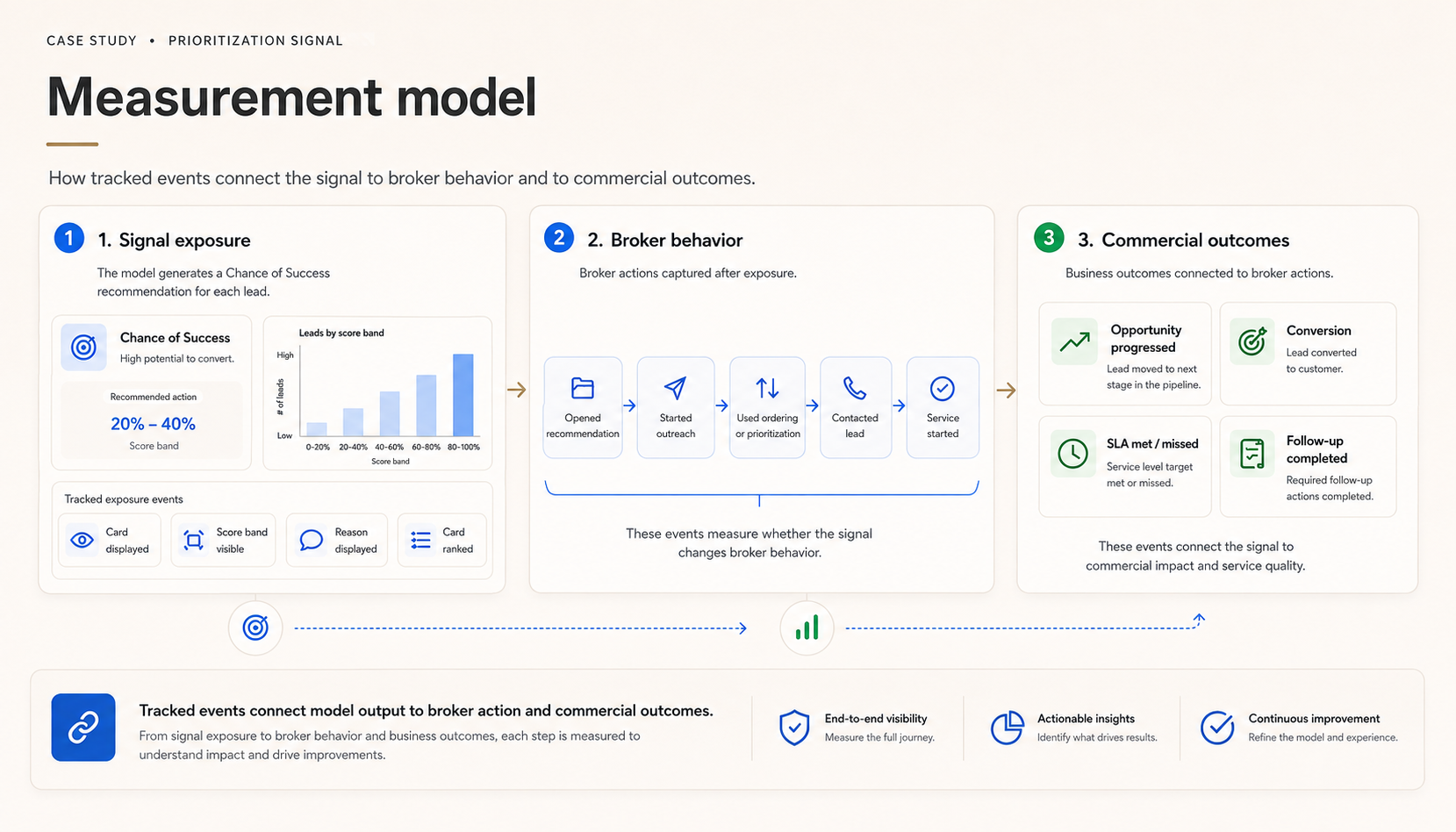
Constraints and trade-offs
- Honest: insufficient data must never produce artificial confidence or priority.
- Feasible: the first direction reuses the current list structure and available signals.
- Evolvable: initial rules may not match observed outcomes, so bands are compared against progression and conversion after release and refined.
- Generalized: internal scoring logic, weights and commercial criteria stay out of this write-up by design.
Outcome
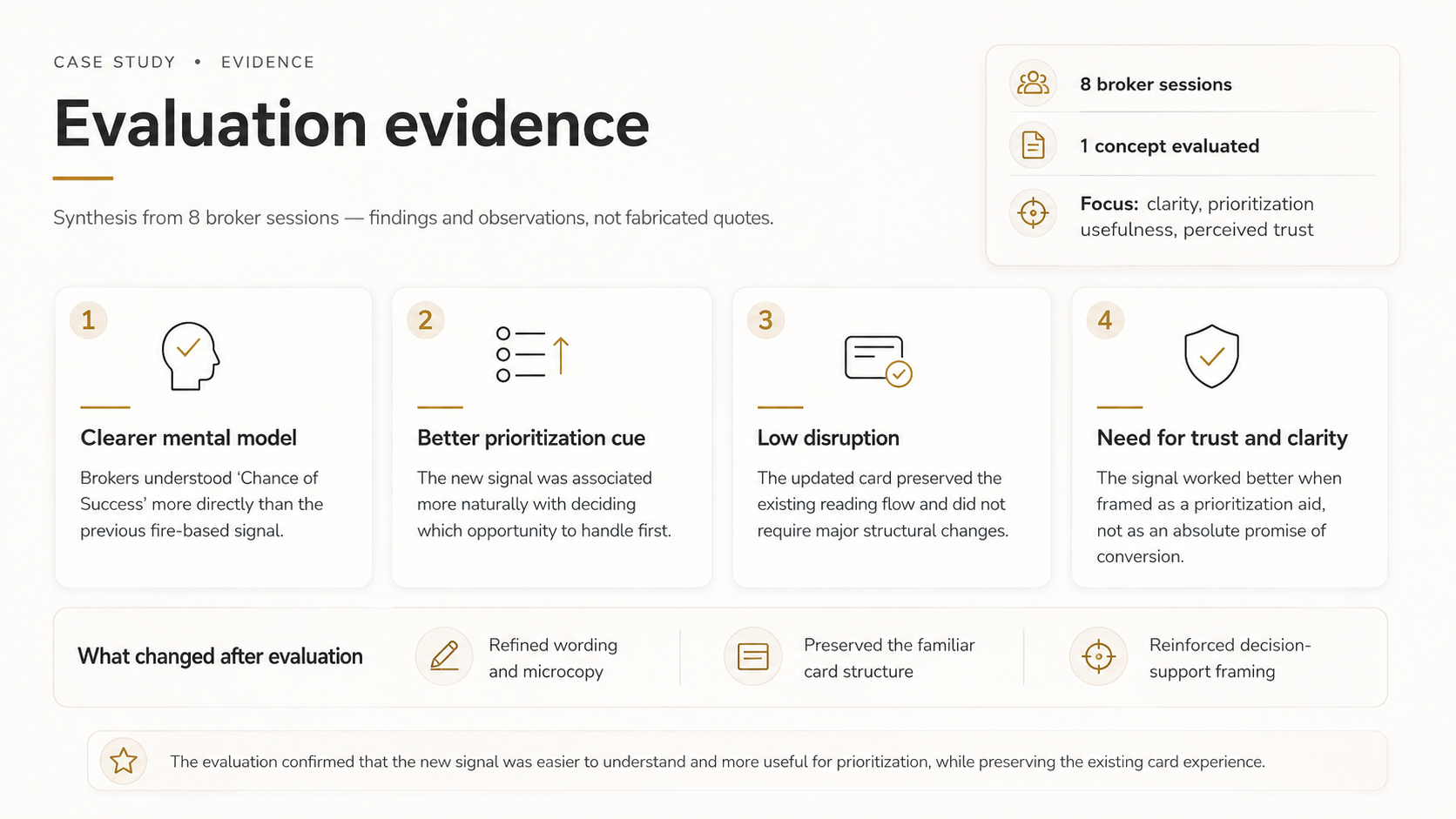
The concept was evaluated through interviews and a concept presentation with eight brokers, focused on the clarity of the mental model, its usefulness for prioritization and confidence in the card-level signal. The direction was consistently well received and required no structural change.
What this case carries is product framing, cross-functional definition, user evaluation and implementation readiness.
Delivered
- Approved direction, signed off by the PM, a business stakeholder and Design coordination.
- Card experience, state system, microcopy and insufficient-data behavior.
- Concept evaluation with eight partner brokers.
- Tracking requirements, Jira items and acceptance criteria.
Not measured
- Production adoption, implementation has not started.
- Commercial impact or change in broker behavior.
- Accuracy of the initial rule-based classification against real outcomes.
Next case
BEES