01Porto2026
GDO Acceleration Plan
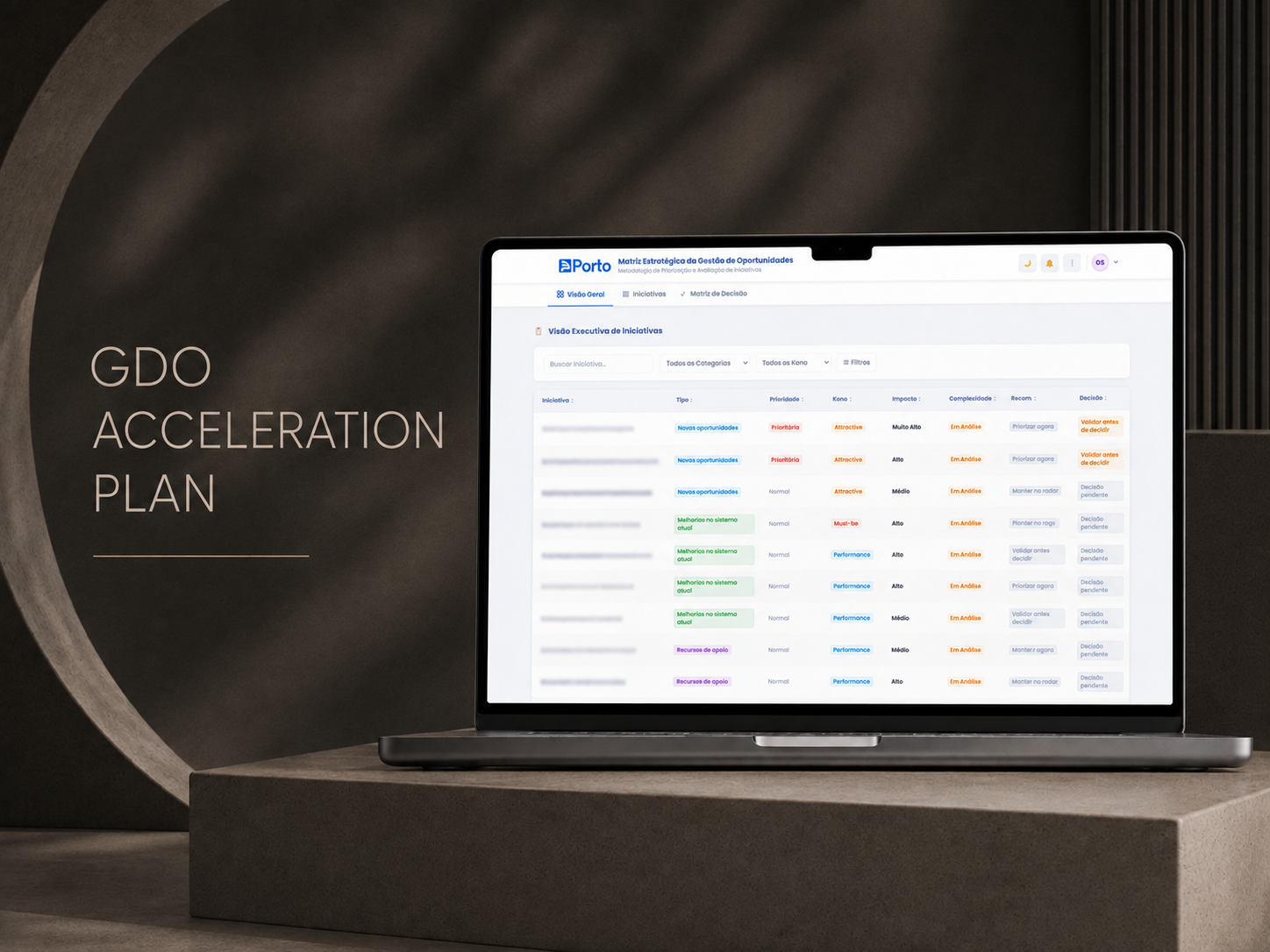
AI ASSISTEDAn open sales question turned into an operable opportunity model
From
To
Which opportunities exist, how do we compare them, and what decides the order?
- Role
- Scope
- Team
- Period
Current state
Context, problem and intervention
Context
GDO is Porto's opportunity-management product for insurance brokers. Coordination arrived with a business question rather than a feature request: how could the product help brokers sell more? The work started by examining the opportunity structure behind that question, before deciding what GDO should build.
Problem
There was no scoped problem and no shared inventory of what the product could plausibly do about the question. Nothing could be prioritized while the opportunity space itself was undefined.
Intervention
I built the opportunity space as a structured object: a taxonomy linking frictions, proposals, opportunities and initiatives, a prioritization logic, and a functional React application that makes the model operable.
Question, model, prioritization, tool
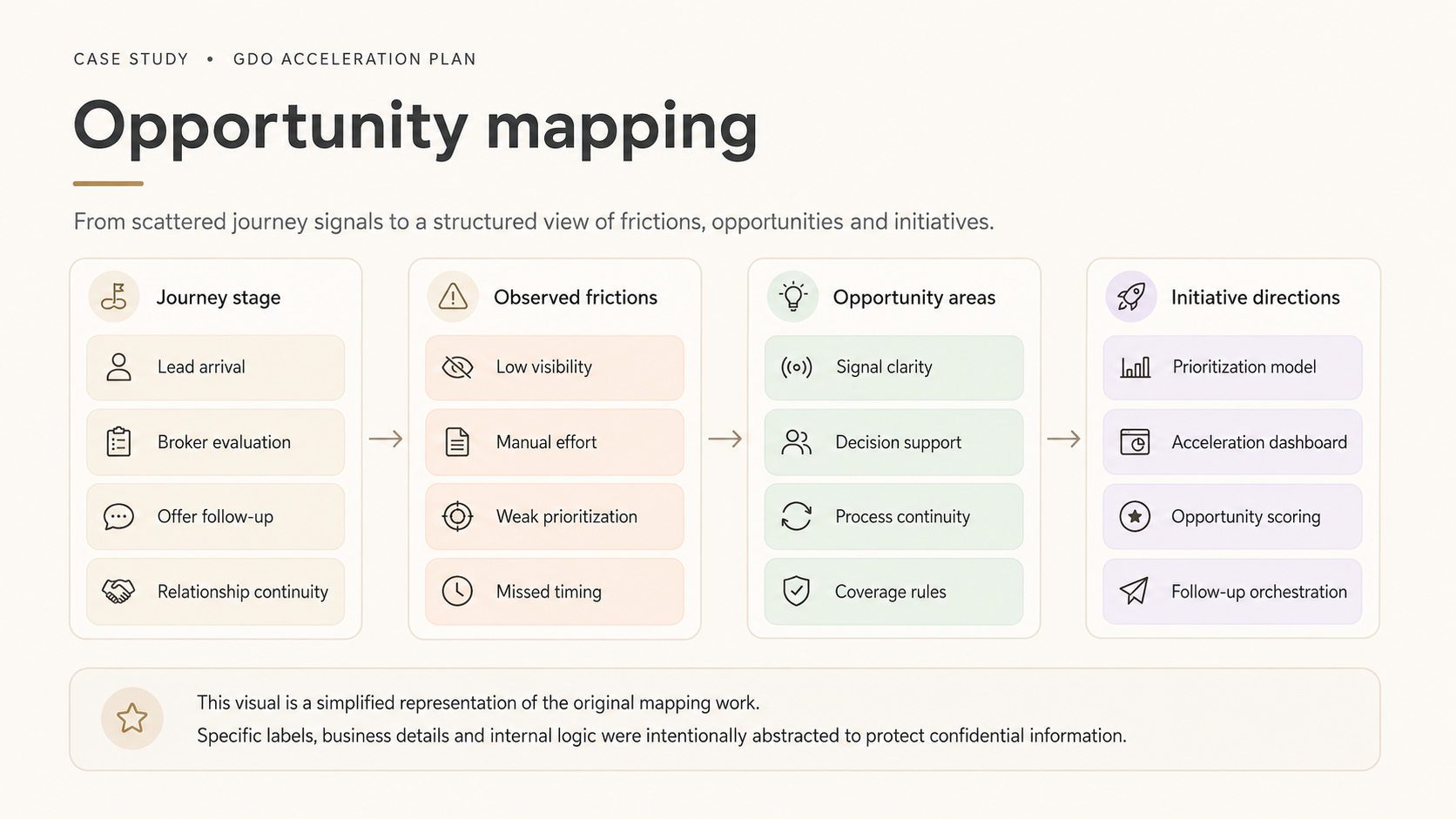
Treat an open question as a portfolio problem
The request could have been answered with a feature list or a dashboard mockup.
- Evidence
- Nothing could be prioritized while the opportunity space itself remained undefined and unshared.
- Decision
- Run the strategic analysis first: Product Value Chain work, an agnostic sales-journey analysis, product-correlation mapping, process analysis and friction mapping, then classify the results into a portfolio.
- Trade-off
- Weeks passed before anything visible existed for stakeholders to react to.
- Consequence
- The team gained a structured object to argue about rather than a list of opinions.
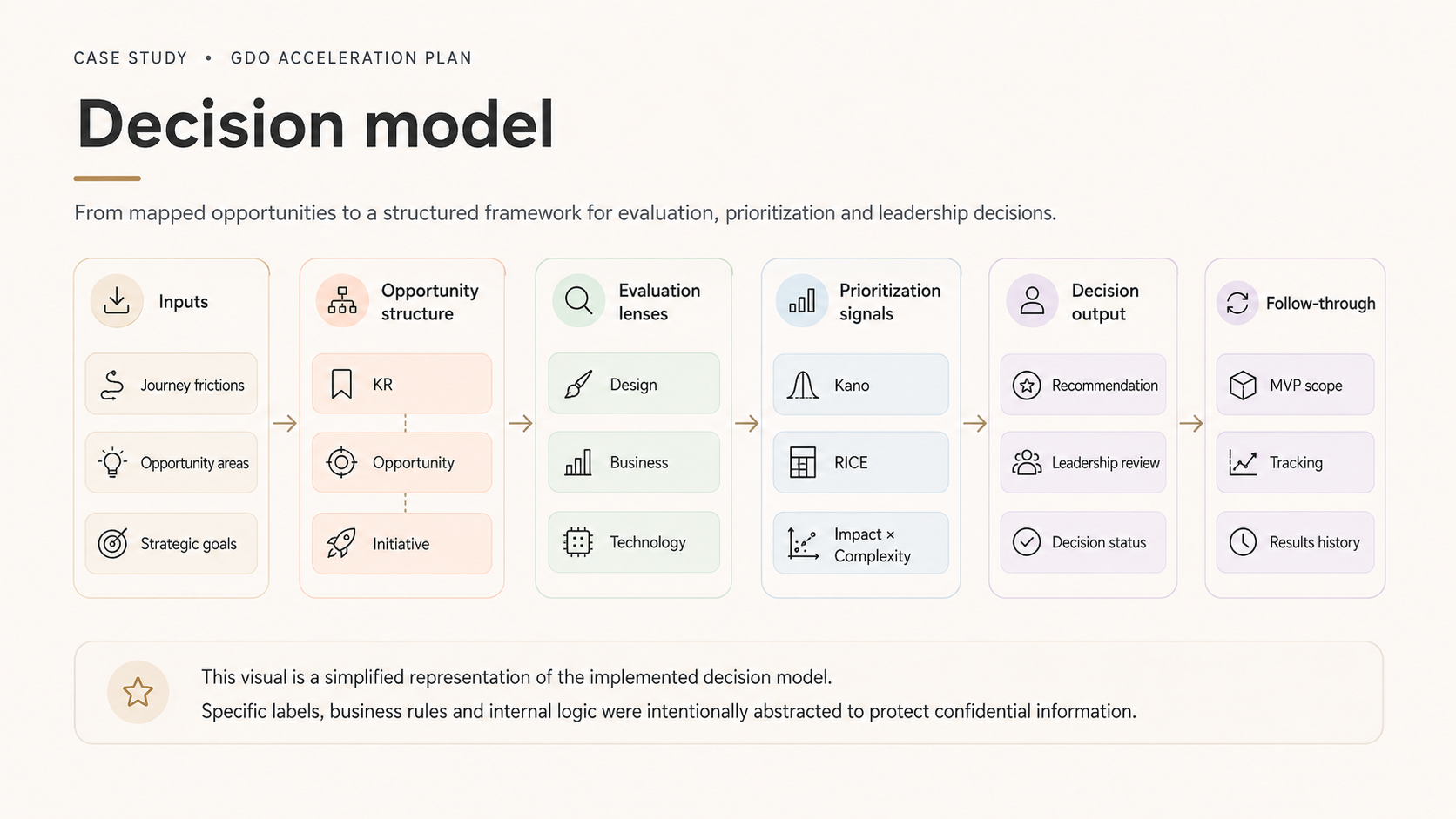
Turn the opportunity model into an explicit decision system
A taxonomy could organize the portfolio, but it would not tell the team how to compare competing initiatives.
- Evidence
- Applying Kano, RICE and impact-versus-complexity across the initiative set exposed where evidence was sufficient, incomplete or conflicting.
- Decision
- Structure inputs into KRs, opportunities and initiatives; evaluate them through Design, Business and Technology; then combine Kano, RICE and impact × complexity into explicit recommendation and decision states.
- Trade-off
- The model reduces discretionary flexibility: incomplete or conflicting inputs remain visible instead of being resolved by intuition.
- Consequence
- The resulting decision logic is auditable, recommendations can be traced back to the structure, evaluations and signals that produced them.
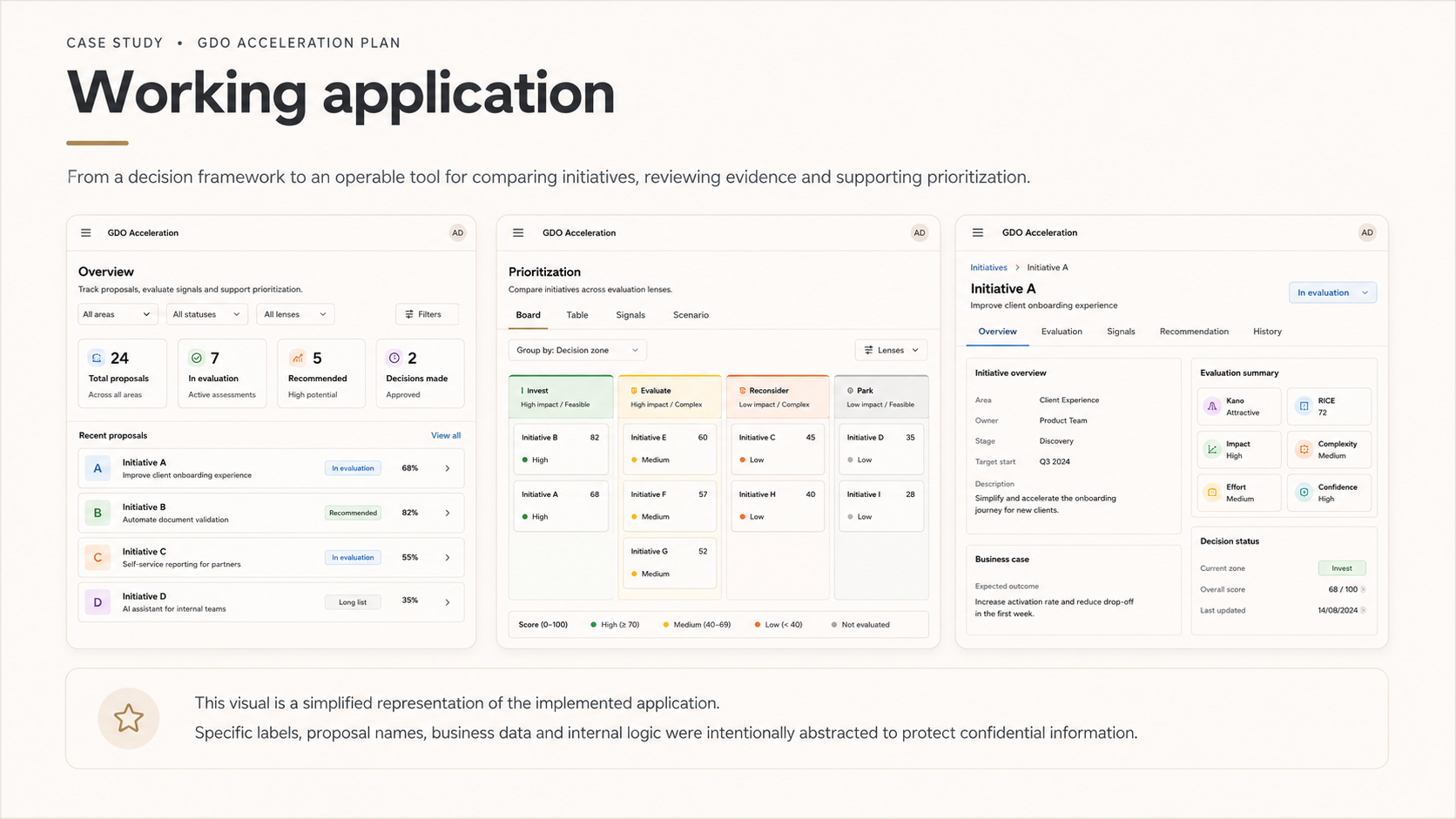
Ship a working application instead of a diagram
A prioritization model presented as slides is evaluated as an opinion.
- Evidence
- The decision states, filters and comparisons only demonstrate their value when someone can operate them.
- Decision
- Use AI-assisted development to build a functional React, TypeScript and Vite application carrying the real initiative dataset, with technical fields left for Technology to complete.
- Trade-off
- It is an internal decision prototype, there is no collaboration layer and no production hardening.
- Consequence
- The initiative was approved for presentation to Business and Design as a working tool.
AI-assisted development workflow
01 · Define
02 · Structure
03 · Gemini
04 · Figma Make
05 · Review
06 · Output
Evidence
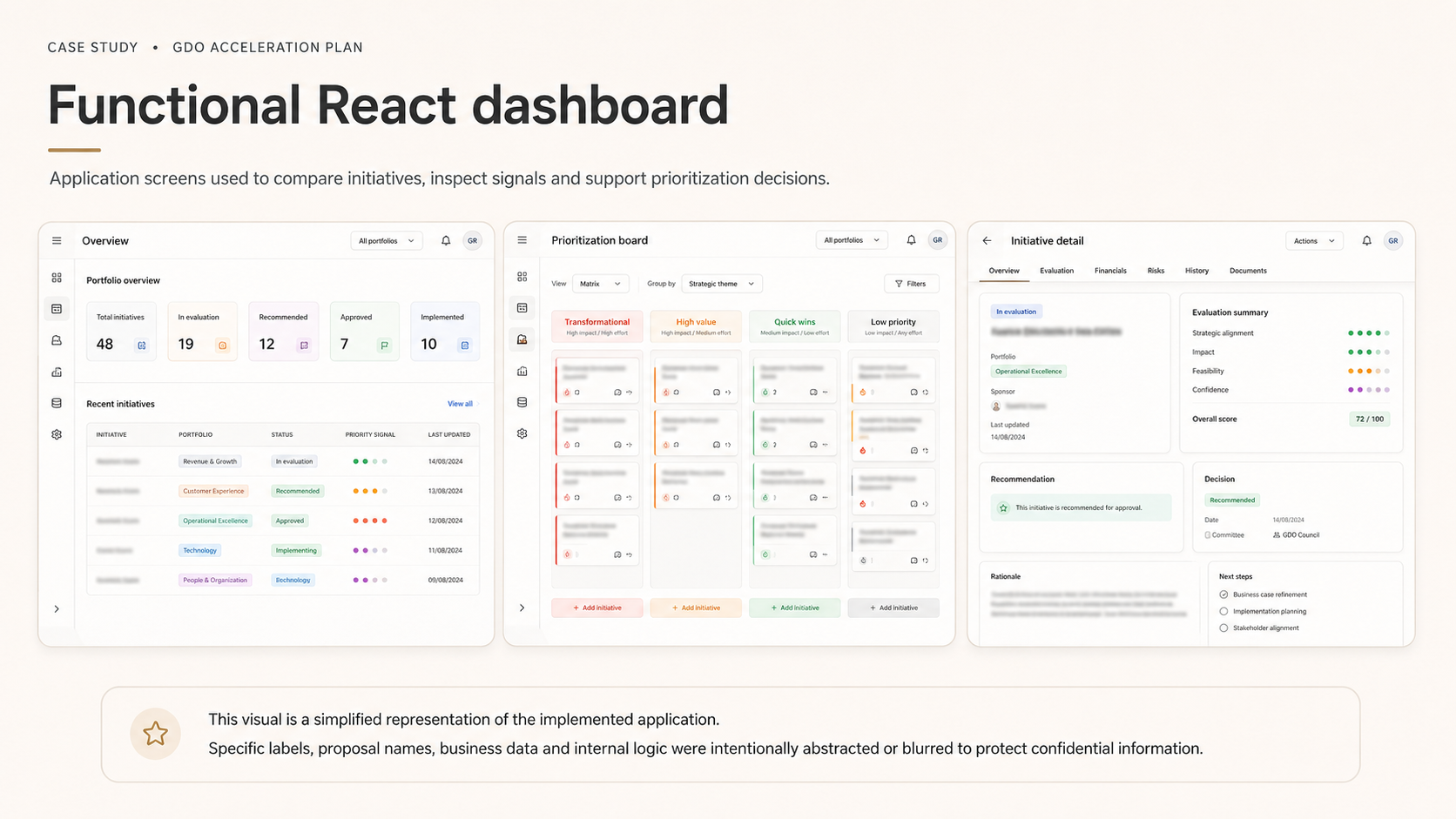
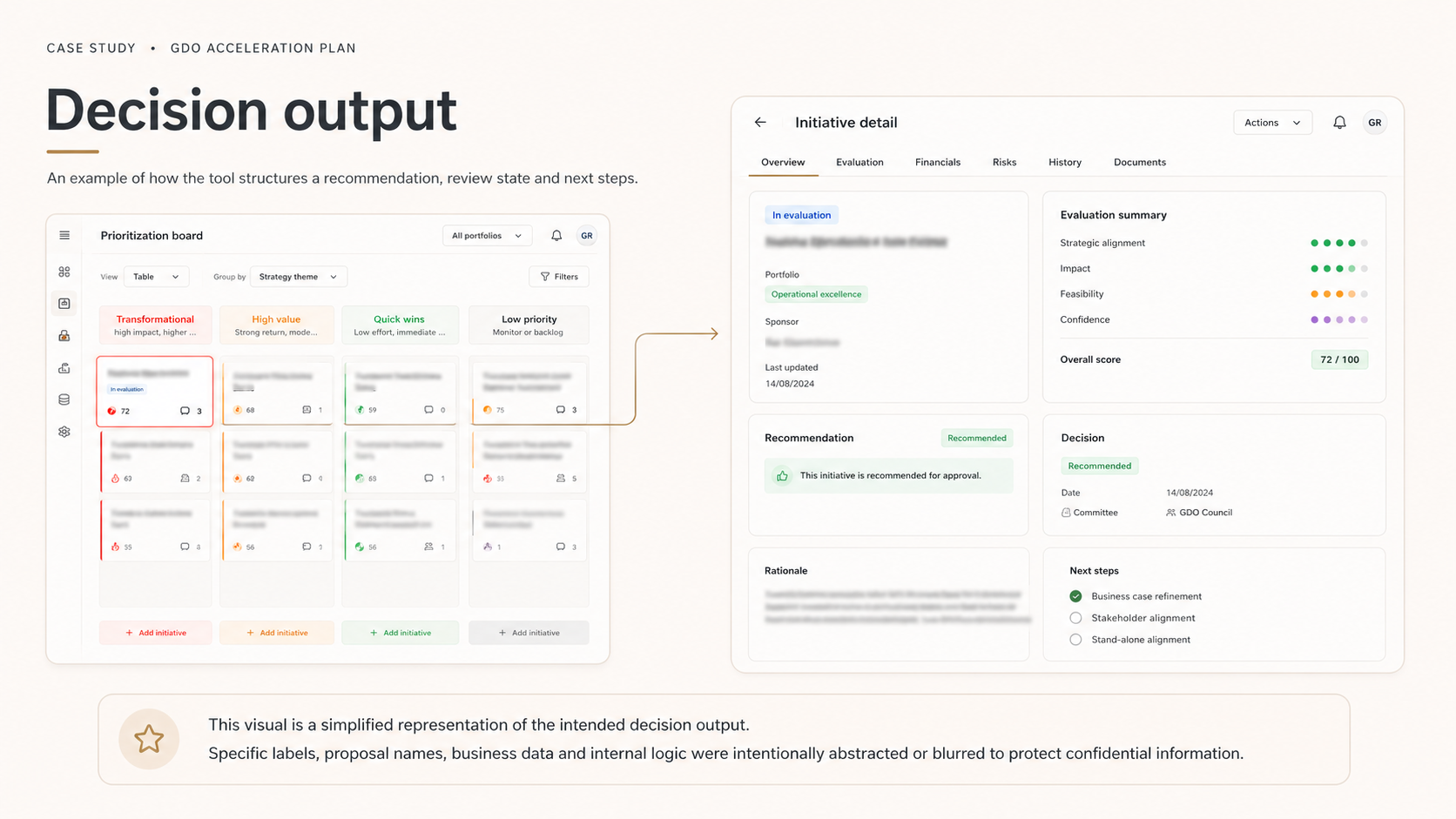
Interactive prototype
The functional React application running live, carrying the real initiative dataset.
Interactive prototype
Need access? Contact me to request access to the interactive demo. Contact me →
Constraints and trade-offs
- AI accelerated implementation; it did not produce the strategy, the taxonomy or the prioritization logic.
- I own the strategic approach, decision model, taxonomy, application architecture and dashboard behavior; a peer Product Designer supported the initiative.
- This front is separate from the lead-distribution engine squad, where I hold design responsibility on a different initiative.
Outcome
The model, the prioritization logic and the application exist and hold the real initiative dataset. What remains is a technology evaluation once the technical fields are completed, and the first prioritization decisions actually taken through it.
The case will carry a stronger claim then. For now it stands on the model and the working tool.
Delivered
- Complete opportunity model, taxonomy and prioritization logic.
- Functional React application carrying the real initiative dataset.
- An AI-assisted build workflow that produced a working tool rather than a proposal.
Not measured
- Organizational adoption: the tool is not yet in use by Business, Technology or Design.
- Any backlog or prioritization decision produced through the application.
- Productivity or sales impact of any kind.
Next case
Chance of Success